
A single good line is luck. A feed where every post looks like it came from the same person is a system — and systems are buildable in about twenty minutes. This article is the build sheet: what to freeze, what to let vary, how to order a series so it reads as authored rather than generated, and how to change the system later without breaking the recognition you have spent weeks earning.
The core paradox to hold onto: feeds punish variety in mechanics and reward variety in content. Most people get this exactly inverted — they change the font every week and post the same three jokes. The fix is boring and it works: freeze five things, vary three.
Why a series is worth the effort at all
A single post is judged on its line. A series is judged on something else entirely — whether the account looks like it belongs to a person with a system. That is the entire value, and it is worth naming plainly because it is easy to mistake for vanity.
Three concrete payoffs. Recognition: a follower scrolling a feed of reposts and screenshots stops at your post because the field colour is one they have seen before, which is a decision made in about a third of a second and cannot be argued with. Memory: people recommend accounts, not posts — “there’s this green text thing” only works if the green text thing is consistent enough to be a thing. Expectation: a series gives the audience a form to recognise and a content to be surprised by, which is the same pleasure structure as a good column or a tracklist. The mechanics are the promise; the words are whether you keep it.
The honest cost: a series caps how much you can experiment visually for as long as it runs. That trade is worth making for six to twelve posts at a time, and worth unmaking afterwards. It is not a lifestyle.
The five constants — never change these
| Constant | What to lock | Why it is the one that matters |
|---|---|---|
| Field colour | One hex, written down | Colour is recognised faster than type; it is the first thing a follower notices missing |
| Type treatment | Weight, size ratio, blur level | The edge quality is the voice; two weights of the same font read as two different accounts |
| Case | All lowercase, including names | One capital in a series of lowercase posts reads like a mistake, not like emphasis |
| Punctuation policy | Final stop or no final stop — pick one | Deadpan weight comes from consistency; mixing the two makes each post look undecided |
| Export geometry | One ratio for the series | The grid is where a series is judged; mixed ratios make the profile look like three accounts |
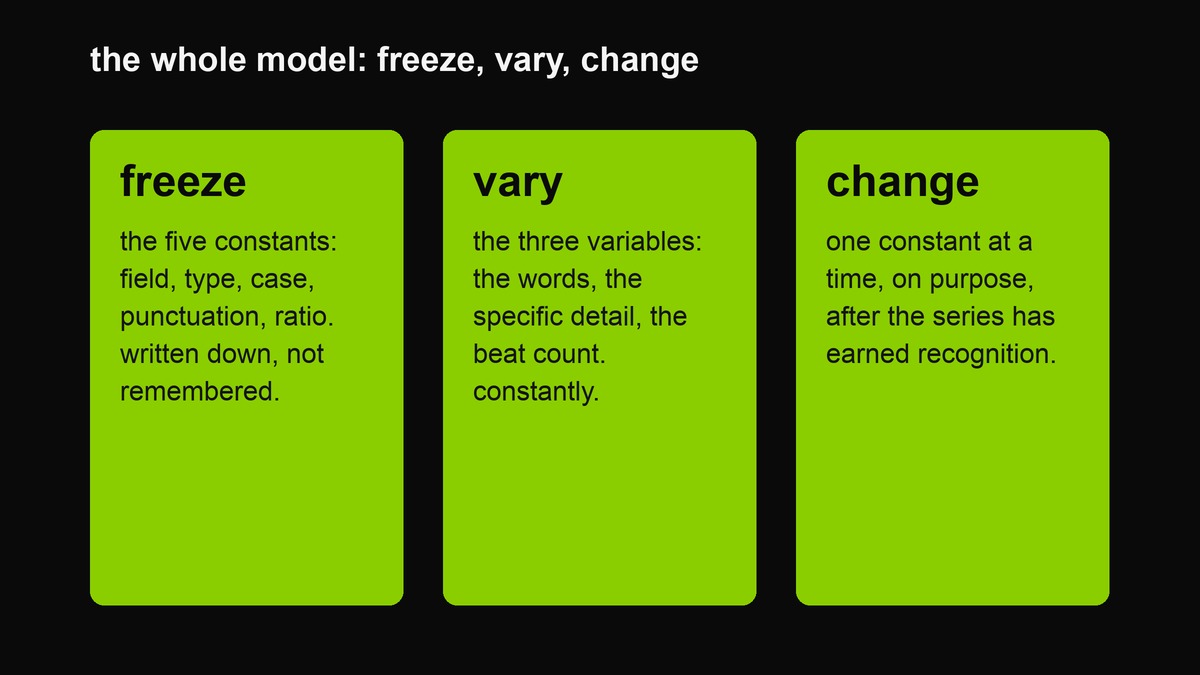 The whole model in three boxes. Freeze the mechanics, vary the content, and change the system only on purpose.
The three variables — change these constantly
The words. Obvious, and still the thing people under-vary. If every line in the series shares a grammatical shape, the series reads as one sentence repeated.
The specific detail. The place, the hour, the object, the person in your life who keeps being mentioned. Details are what make a locked system feel alive instead of templated — the mechanics say “this is mine”, the details say “this is today”.
The beat count. One beat, three beats, five beats. Within a fixed type treatment, varying sentence length is the only musical dimension left, and it is the difference between a series and a screensaver.
Locking the system in four moves
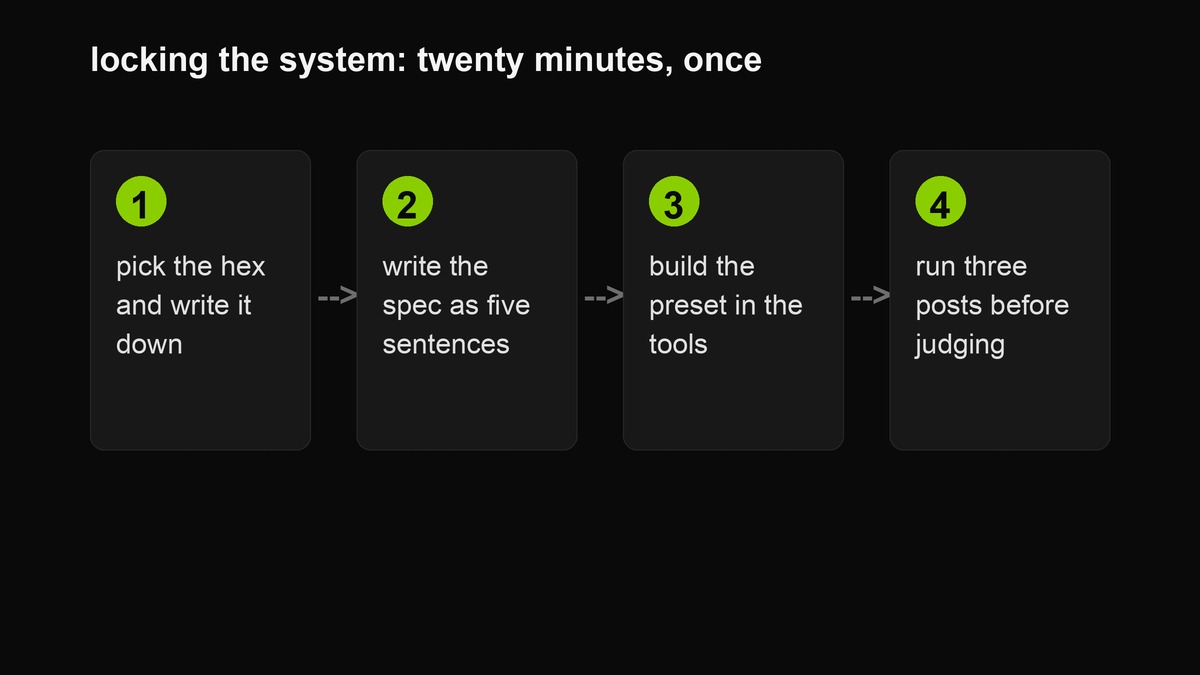 Twenty minutes, once. After this the decisions are already made and every post is only about the words.
Move one — pick the hex and write it down. Not “that green”: the actual value. The green page lists the family and tells you whether your chosen text colour clears contrast; the palette tool gives you the supporting tones you will need for cards and highlights later. Copy the values into a note on your phone. A system you cannot copy-paste is not a system.
Move two — write the spec as five sentences. Field, type, case, punctuation, ratio. Five lines, in plain words, that you can check a post against in ten seconds. If you cannot write the spec, you do not have a system yet — you have a habit, and habits drift.
Move three — build the preset. The template maker holds the ratio, style and background; the sticker maker handles the transparent variants you will want for stories. Note your three settings (size, style, background hex) — the tools are stateless by design, so the memory lives in your spec, not in a cookie.
Move four — run three posts before judging anything. One post tells you nothing; three posts in the same system show you whether the constants are actually supporting the words or strangling them. Adjust the variables, not the constants.
The spec card, written out
Here is a finished spec, so you can see how short the thing is supposed to be. Copy the shape, change the values:
SERIES 01 — field notes
field: #8ACE00 · type: black, heaviest weight, one size for the line
case: lowercase always · punctuation: final stop on the last beat only
ratio: 1:1 for the grid · 9:16 for stories, same everything else
variables: the words, the detail, the beat count (1 to 5)
Five lines. If your spec needs a paragraph per constant you have not decided yet, and the series will drift within four posts. The spec is also the thing you hand to future-you when you are posting tired: it removes decisions, which is the whole point of building it.
One more practical note — write the spec before you post the first entry, not after the fifth when the drift is already visible. Locking a system you have already accidentally created is harder than deciding one, because you have to reverse-engineer your own habits and they are always less deliberate than they look.
Ordering a series so it does not flatten
Once the mechanics are frozen, sequence becomes your only expressive tool, and there are three rules of thumb worth following.
- Alternate loud and quiet. A one-word post after a five-word post reads as a punchline; the same one-word post after another one-word post reads as a glitch. Roughly every other post, change the energy as well as the content.
- Never run the same shape three times. Two questions in a row is a pattern; three is a tic. The ten shapes exist so you can rotate.
- Leave one anchor post per week. One post that states something plainly — not a joke, not a bit — is what keeps a series from reading as performance art. The register survives sincerity; it does not survive pure repetition.
One system, several surfaces
The moment a series leaves the grid it meets ratios that will break it, so decide the mapping in advance rather than per-post. The rule that holds up: the constants survive the ratio; the layout does not. A line sized for a square canvas is too small on a story and too large on a banner; the field colour, case and punctuation policy should not care.
| Surface | Ratio | What changes | What must not |
|---|---|---|---|
| Feed grid | 1:1 | type size; usually one or two beats | field, case, punctuation |
| Story / reel cover | 9:16 | line sits higher; more empty field below | field, case, punctuation |
| Timeline card | 16:9 | shorter lines only; three beats maximum | field, case, punctuation |
| Sticker overlay | trimmed | outline appears; field becomes transparent | case, punctuation, weight |
The sticker row is the one people get wrong: a transparent sticker has no field, so the colour identity leaves and only the type identity remains. That is fine for a series that has already established its voice, and confusing as a series opener. Export the same line in both forms and put the fielded version first.
Cohesion is not the same as repetition
The failure mode of doing this correctly is that it starts to look like the same post. The diagnostic is simple: cover the image and read only the words. If the last four lines could have been written in any order, you have repetition, not cohesion. Cohesion means the mechanics rhyme; the content should still progress.
When you feel the system going stale — usually around post twenty — change one constant, and change it in a way that keeps the recognisable thing recognisable. Swap the field colour for its neighbour from the tint row, not for a different hue. Add a second type size, do not switch typefaces. Change the ratio, keep the colour. One variable at a time, and the audience experiences it as an evolution instead of a new account.
A worked six-post series
| # | Line | Beats | Why it belongs to the series |
|---|---|---|---|
| 1 | out of office. into the weekend. | 2 | establishes field, case, final-stop policy |
| 2 | the chat is feral. it stays that way. | 2 | same shape, new subject — the pattern becomes intentional |
| 3 | bed. | 1 | the quiet beat; only lands because two and four exist |
| 4 | new gym. old me. we will see. | 3 | beat count moves, mechanics identical |
| 5 | still ringing. the setlist knew. | 2 | specific detail carries it; shape is deliberately familiar |
| 6 | fine. fully fine. ask again. | 3 | closes the loop with a turn the series earned |
Read down the beats column: 2-2-1-3-2-3. That variation, inside five frozen constants, is the whole difference between a series and a template. Notice also that the quiet post sits at three, not one — a series that opens with a single word looks like it has nothing to say; the same word after two full lines is a beat of silence.
Breaking the system on purpose
Once a series is recognisable, recognition becomes a resource you can spend. The deliberate exception — one post that breaks exactly one constant — hits harder than any line in the series precisely because the system trained the eye to expect the other version. The one-word post with no field. The post where the colour inverts. The one with a capital letter, used as a shout.
Three rules keep this from destroying the series. One constant per exception — break two and it is a different account, not a joke. Roughly one in eight — a series of exceptions has no baseline to deviate from, and the effect dies the moment it becomes expected. Never break the case and the colour in the same post — those two are what the audience is actually tracking, and losing both at once reads as abandonment rather than punchline.
After the exception, post the plainest, most by-the-book entry in the series. The return to normal is the second half of the joke, and it re-establishes the baseline the next exception will need.
The ten-second audit
- Same hex as every other post? (field)
- Same weight and edge quality? (type)
- Any accidental capitals? (case)
- Final stop matching the policy? (punctuation)
- Right ratio for the grid? (geometry)
- Would the last three lines survive being shuffled? (progression)
- Could a stranger tell which post is the anchor? (variety)
Seven checks, ten seconds, before every post. The first five protect the system; the last two protect you from the system.
Recovering a series that has already drifted
If you are post fifteen into something that used to look like a series and now looks like a moodboard, do not quietly fix it going forward — nobody will notice the repair, they will only notice the mess. Do it loudly. Post one entry that is the purest possible version of the original system: the exact field, the exact type, a line that could not belong to anyone else. That is the reset. Then, in the caption, say the boring true thing — that the series got away from you and this is what it is.
Two follow-ups make the reset stick. First, delete or archive the three worst offenders from the grid; a series is judged on its average, and two stray posts drag the perceived pattern more than four good ones lift it. Second, rewrite the spec card as if you were starting over, because the drift almost always came from an ambiguity in the original — a constant that was never actually pinned down, like “roughly this green” or “usually no final stop”. Vagueness in a spec is deferred drift.
Expect the reset to perform worse than the good posts did. A series re-establishing itself is a tax you pay once; the alternative is a grid that slowly stops looking like anything.
FAQ
How long should a series be?
Six to twelve posts is the natural arc — long enough for a pattern to be perceived, short enough that you can hold the thread. After twelve, either end it explicitly or change one constant and start a new numbered run.
Can I run two series at once?
Yes, if they differ on at least two constants — different field colour and different ratio, say. Two series that share five constants read as one series that keeps changing its mind, which is the fastest way to lose the recognition a series is for.
What if my whole account is not brat?
Then the series is a section, not the grid. Runs of three to five matching posts inside a mixed feed work well — the contrast with your other content makes the series read as deliberate. The one thing that does not work is a single brat post alone in a feed of photos; that reads as a mistake.
How do I know the series has ended?
When you are repeating lines rather than repeating mechanics. The system is supposed to be able to hold any sentence; the moment you find yourself writing the same thought in new clothes, the premise is exhausted and the series should close with a deliberate last post — ideally the best one you have.
Should I number the posts?
Only if the numbering is part of the joke. A visible count makes the series feel like a project, which is good for the first six posts and starts to feel like homework after twelve. The alternative is no numbering at all and letting the mechanics do the signalling — which is the more confident choice and usually the better one.
Does the series need a theme?
No, and a theme is usually a trap — themed series exhaust their premise in four posts. A system with varied content outlasts a premise, because the system can hold any sentence and a premise can only hold the ones that fit it.
Related on this site: the seven-pass method for producing the lines, the three dials for judging them, and the green page for the colour values. This site is independent and unaffiliated with any artist or label.
[…] The same logic governs a series: pick a layout shape — say, two lines with a shorter second — and hold it across every post so the rhythm of the feed comes from the words changing, not the structure. That is the layout half of the consistency guide. […]
[…] one and write the six values down — the same discipline the series guide describes for everything else. A palette you re-pick per post is not a palette, it is a mood, and […]
[…] wall generator, the green colour page for the exact values and their contrast behaviour, and the consistency guide if the wallpaper is part of a […]
[…] the tracklist maker, the consistency guide for holding one system across a release, and the platform guide for the sizes the set […]