
The other two craft articles on this site explain the register: the three dials describe why a line feels right, and the poster line guide lists the shapes a line can take. This one is the workshop. It is the procedure — seven passes you run on any ordinary sentence until a brat line falls out — plus the drills that make it fast enough to do while the post is still open in another tab.
Everything here is mechanical on purpose. Inspiration does not scale; a method does. If you only remember four of the seven passes, remember the first four — they do most of the work.
The order matters more than the steps
People run this procedure backwards: they rewrite for attitude first, then try to shorten. That fails because an attitude-pass on a bloated sentence just produces a shorter bloated sentence with swagger. The correct order is destructive before creative — you remove until only the load-bearing words are left, and only then do you arrange them.
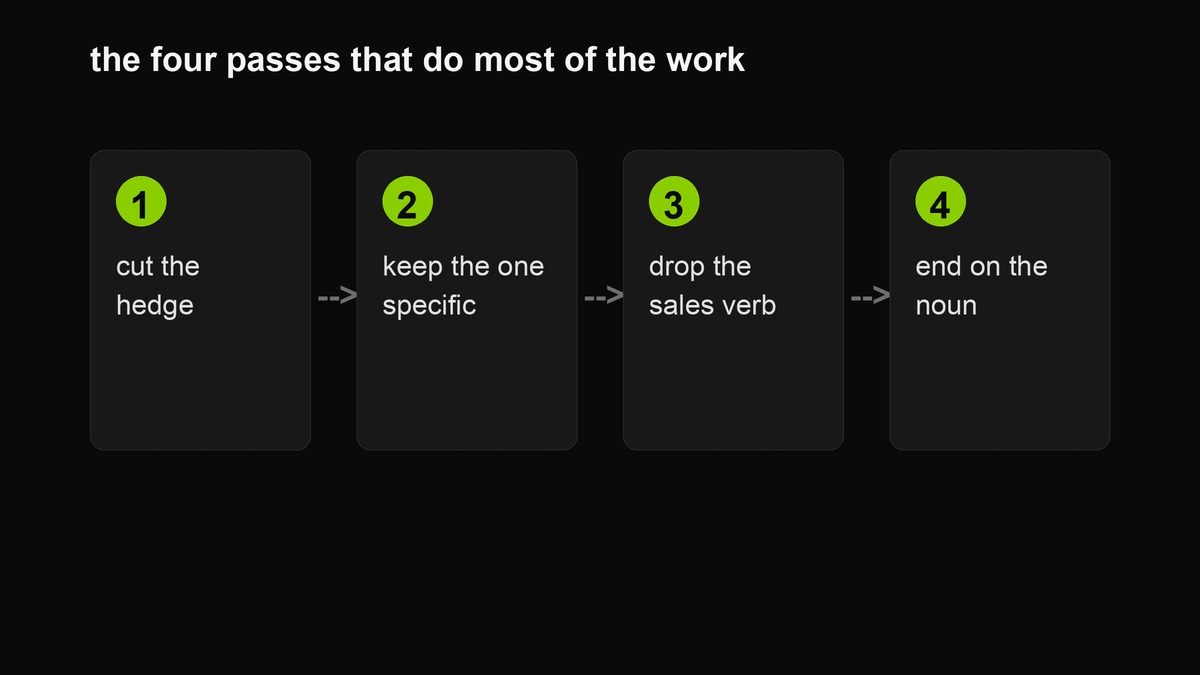 The first four passes — the ones that do most of the work. Each pass makes the next one smaller.
The logic of the order: hedges are deleted before anything else because they change how much room the real words have. Specific nouns get chosen before reordering because you cannot put the payload last until you know which word is the payload. The sales verb goes before punctuation because a line that still has to persuade nobody does not need three beats, it needs one. Every pass exists to make the next pass easier, which is why skipping one makes the whole thing feel harder than it is.
Pass zero: pick a sentence that can survive
The method is destructive, and not every sentence is destructible. A brat line is a statement with an attitude attached, so the input has to contain a statement. Run this checklist before you start cutting, because it saves you from polishing something that cannot work:
- Does it assert something? Questions, requests and explanations have to stay sentences. “does anyone know a good dentist” cannot become a line; “the dentist won” can.
- Is there a thing in it? A noun you could photograph. Times, places, objects and body states all qualify. Opinions do not.
- Would you say it out loud to a friend? If the sentence only exists as a written announcement, it is marketing material, and marketing material resists every one of the seven passes.
- Is the feeling aimed at a situation? If the feeling is aimed at a person, stop before the method sharpens it into something you will delete.
When an input fails the checklist, the fix is upstream: add a detail, state the thing plainly, or pick a different moment to post about. Most failed lines are failed inputs, not failed edits, and recognising that is the difference between rewriting and fiddling.
The seven passes
Pass one — find the noun
Underline the most concrete thing in the sentence: the pasta, the 8am, the last train, the group chat. If there is no concrete noun, stop — the sentence is an opinion, and opinions do not survive this format. You need a thing the reader can picture.
“i keep ordering the same thing every time” → the noun is “the same thing” — too vague. fix the input first.
Pass two — delete the introduction
Everything before the actual news is throat-clearing: I think, just so you know, honestly, so, anyway, a little update. Delete it entirely. The sentence you were saving for the end was the one you should have started with.
“so yeah just a small update that the deadline moved” → “the deadline moved”
Pass three — kill the hedges
Now the smaller qualifiers: maybe, kind of, sort of, a bit, pretty, quite, somewhat, I guess, to be fair, no idea if anyone else but. Each one is the writer checking permission to speak. Delete them all; the sentence gets shorter and the voice gets taller in the same motion.
“i might be a little obsessed with this song” → “obsessed with this song”
Pass four — drop the sales verb
Check it out, stay tuned, don’t miss, you need to, wish me luck, let me know — any clause where the line asks the reader for something. This format never asks. If the only thing left after deleting the ask is the statement, the statement was always the line.
“new menu drops friday, you are going to love it” → “new menu. friday.”
Pass five — compress clauses into beats
Replace conjunctions with full stops. A subordinate clause is a beat waiting to be free: “bed because i am tired” is one sentence; “bed. tired.” is two beats with the same words. Aim for two to four beats total — past four you are writing a paragraph with periods.
“i am staying in tonight because honestly the group chat is exhausting” → “in tonight. the chat is exhausting.”
Pass six — move the twist last
The final word is the one that lands. Reorder so the interesting word — the specific noun, the judgment, the turn — sits at the end. This pass is why the previous five exist: you cannot see the twist until the filler is gone.
“chaotic, but it was a good night” → “good night. chaos, mostly.”
Pass seven — lowercase and punctuate for weight
Lowercase everything. Then choose the punctuation by feel: a full stop on the last beat adds deadpan weight; no final stop reads more casual; a comma is allowed once, and only if the line needs a breath in the middle. Exclamation marks are not on the menu.
“Good night, chaos, mostly.” → “good night. chaos, mostly.”
One sentence, all seven passes, shown live
The intermediate states matter, because that is where people learn which pass they keep skipping. Input: “honestly i think the group chat has been getting a little out of hand lately and i am not even mad about it”
| After pass | State of the line |
|---|---|
| 1 — noun | the chat is the only thing here worth keeping |
| 2 — intro | honestly i think the group chat has been getting a little out of hand and i am not even mad about it |
| 3 — hedges | the group chat has been getting a little out of hand and i am not even mad about it |
| 4 — sales verb | the chat is out of hand. i am not even mad about it. |
| 5 — beats | the chat is out of hand. not even mad. |
| 6 — twist last | chat is out of hand. not even mad. — already ending right; no change |
| 7 — case | out of hand. not even mad. |
Two things to notice. The line got shorter by more than half and lost no information — the deleted words were all posture. And pass six did nothing, because passes three and four had already exposed the twist; when a pass has nothing to do, that is the earlier passes working, not you failing.
Six sentences, start to finish
Compressed runs showing the whole method in one line each. The left column is what someone would actually text; the right is after seven passes.
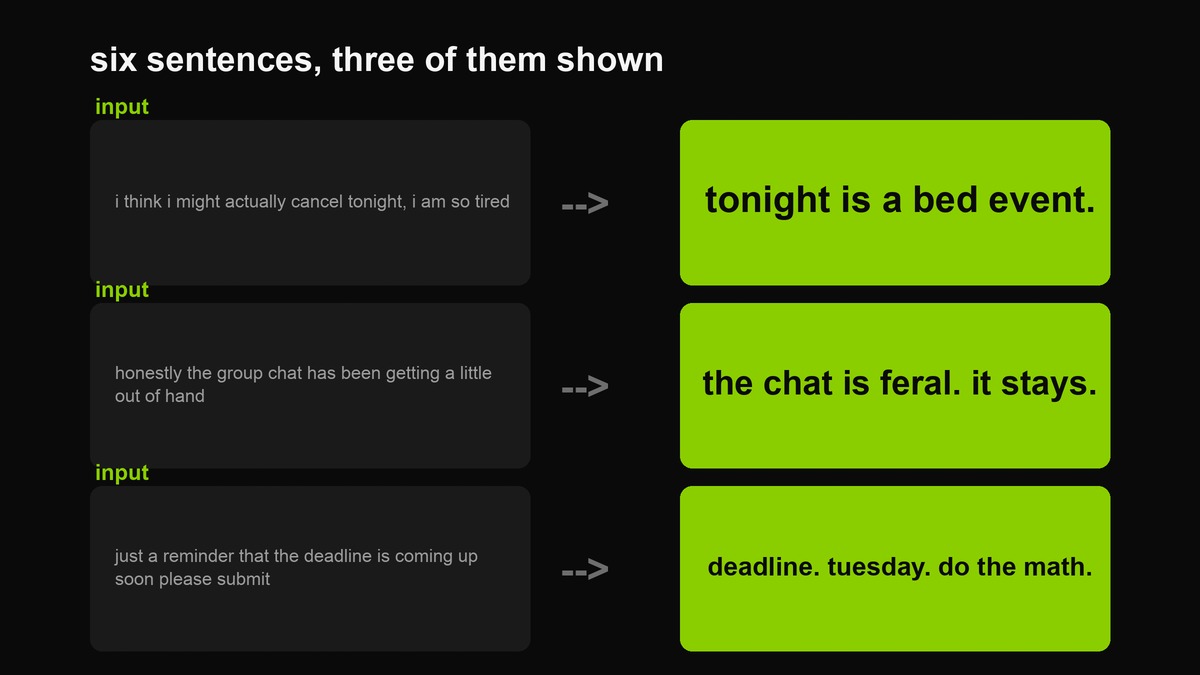 Three of the six, as they look on a canvas. The method is invisible in the result, which is the point.
| Input sentence | After seven passes | Pass that mattered |
|---|---|---|
| i think i might actually cancel tonight, i am so tired | tonight is a bed event. | find the noun (bed) |
| so excited to announce that our new menu drops soon, you will love it! | new menu. soon. | drop the sales verb |
| honestly the group chat has been getting a little out of hand lately | the chat is feral. it stays that way. | kill the hedges |
| just a reminder that the deadline is coming up soon so please submit your work | deadline. tuesday. do the math. | twist last (math) |
| i cannot believe how good that concert was, my ears are still ringing | still ringing. the setlist knew. | compress clauses |
| starting my new fitness journey tomorrow, wish me luck! | new gym. old me. we will see. | delete the introduction |
Running the method on more than one line
The seven passes produce a poster line, but posts have two surfaces — the canvas and the caption — and they should not say the same thing. The working division: the line carries the attitude, the caption carries the context. So run the passes on the line, then write the caption at full sentence length, deliberately un-brattish, with the details the line refused.
That gives you a three-step routine for an actual post: run the seven passes on the sentence you want to say; put the result on a canvas in the generator; write a caption that explains what the line will not. If you find yourself repeating the line inside the caption, the line is not carrying enough and one of the passes was too generous.
For a series of posts — the reason the consistency guide exists — run the passes once per sentence but keep the punctuation policy identical across all of them. Variation in the words, zero variation in the mechanics, is what makes a feed look authored rather than generated.
Drills that make it fast
Three a day. Take three things you actually said today — a text, a reply, a status — and run all seven passes on each. Keep the ones that survive being read aloud. This is the whole practice; two weeks of it and the passes start happening in the first draft.
The fifty-word squeeze. Take any paragraph you wrote recently and get its news into fifty words, then twenty, then eight. Most people discover their paragraph had one sentence in it and seven about their feelings about it.
The swap test. Take a line you like from anywhere — a track title, a bio — and rewrite it with your own specific noun. You are copying the skeleton, not the scar tissue; this is how the register is supposed to be learned.
Read it aloud, then send it cold. The read catches rhythm failures; sending the bare line to one friend with no context catches tone failures. If the reply is a question, the line is not finished.
The audit: score your own line before you post
Five questions, thirty seconds. Two failures means run the passes again; three or more means the input was wrong, not the edit.
| Question | Pass | If it fails |
|---|---|---|
| Is there a word you could photograph? | noun present | go back to pass one; the input has no thing in it |
| Would you say it out loud without wincing? | tone | it is written, not spoken; delete the fanciest word |
| Does it end on the interesting word? | twist last | reorder; do not rewrite |
| Is anything explained? | restraint | delete the clause that tells the reader what to think |
| Could any brand post this unchanged? | specific | add one detail that belongs only to you |
The last row is the one people argue with, and it is the one that matters most for this format. A line that could belong to a bank is a line that belongs to no one — the whole register is built on the assumption that the person posting it has a specific life and is not going to explain it.
Where the method breaks
- Over-cutting. Passes two through four are happy to delete your whole personality if you let them. If the line is now grammatically perfect and completely interchangeable with anyone else’s, put one specific detail back.
- Losing the noun. Sometimes pass three deletes the only concrete thing because it was hiding inside a hedge. Re-read the original after cutting — if nothing is picturable, the line is a mood, not a poster.
- Adjective hoarding. Two adjectives in a line is the single most common failure. One survives; it should be a judgment, not a decoration.
- Explaining. The last beat is a footnote (“which is why i say that”, “lol ignore me”). Delete the footnote. The line is allowed to be odd.
- Running it on the wrong input. An apology, a eulogy, a technical explanation, a request for help — these need their full sentences. The format is for statements with an attitude attached; if the sentence exists to be understood precisely, leave it alone.
FAQ
Do I really run all seven passes every time?
Once you are fluent, no — the first four happen in your head while you type. The full seven are for when a line is not working, or for practice, where the point is doing them slowly enough to notice which one you keep skipping.
What if my sentence has no concrete noun?
Then the input is wrong, not the method. Add a detail before you run the passes: the time, the place, the object, the thing you ate. “tired” has no noun; “3am. again.” has one, and it is doing all the work.
Is this the same as good copywriting?
They overlap on compression and end on different goals. Copywriting wants the reader to do something; this format wants the reader to feel like they overheard something. Delete the call to action and you have moved from one to the other — which is exactly pass four.
Which pass do most people skip?
Pass six, almost always. Writers cut happily and then leave the sentence in the order they thought it in, which is usually the order the least interesting word came to mind. Moving the twist to the end costs one second and is the single biggest upgrade to a line that is otherwise finished.
Does the method work on non-English text?
Partly. Passes one through four are universal — every language has throat-clearing and hedges. Passes five through seven are English-specific: the full stop as a beat depends on a language where sentence fragments read as deliberate, and lowercase-as-tone depends on capitalisation carrying meaning it does not carry everywhere.
Can I use the translator instead of doing this?
As a sparring partner, yes — it runs a fixed rule set and shows every edit it made, so you can disagree with it line by line. As a replacement, no: it works on rules, not on knowing your specific noun. The method is yours; the tool is a mirror.
Further reading on this site: the plain-language basis for passes two and three is summarised by PlainLanguage.gov; the reason compression matters on screens is Nielsen Norman Group’s reading research. This site is independent and unaffiliated with any artist or label.
[…] moves repeat on purpose. Every rewrite here is an instance of the seven passes — find the noun, delete the introduction, kill the hedges, drop the sales verb, compress to […]