
Thirty ordinary sentences — the kind that actually get typed into a caption box — rewritten for this format, each with a one-line note on what the edit did. Use it as a swipe file, but use it honestly: the point of a list like this is to train your ear, not to hand you lines. A borrowed transformation with your own detail swapped in is practice; a copied one is a sticker on the wrong suitcase.
The moves repeat on purpose. Every rewrite here is an instance of the seven passes — find the noun, delete the introduction, kill the hedges, drop the sales verb, compress to beats, move the twist last, lowercase and punctuate. Read the first ten pairs and you will start predicting the edit before you see it, which is the moment the list has done its job.
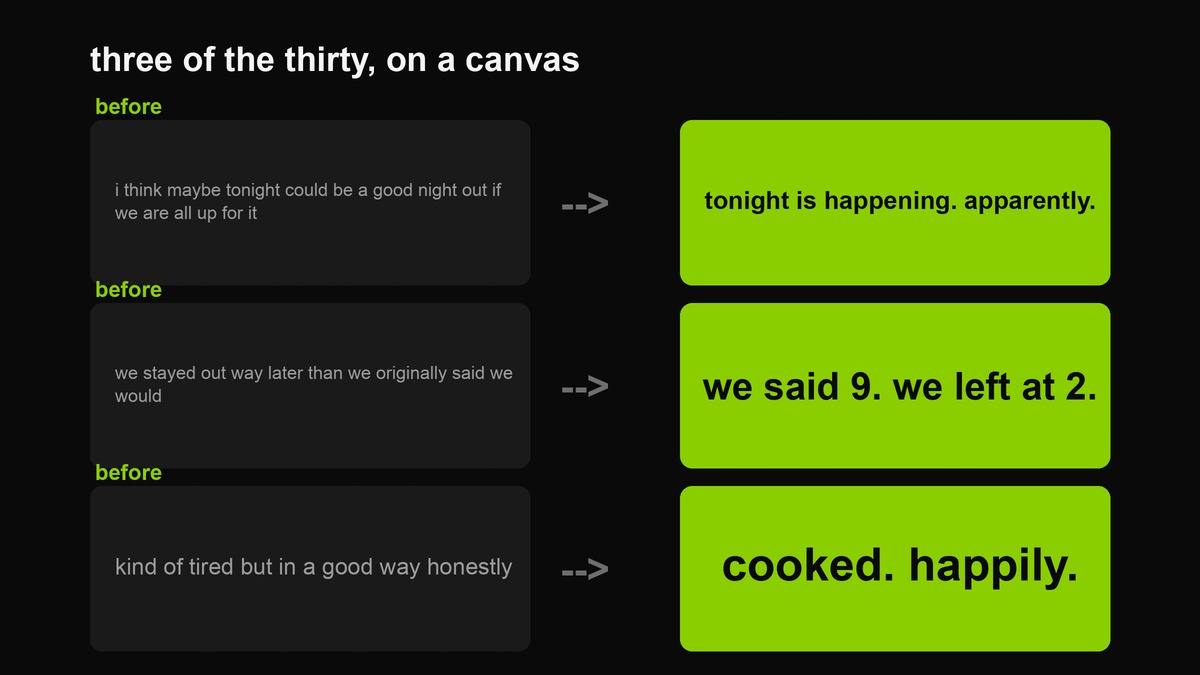 Three of the thirty as they look on a canvas. The left card is what you feel like writing; the right is what reads as confident.
How to read this list
Each entry has three lines: the sentence as someone would actually type it, the rewritten line, and a note naming the move that did the work. Read the notes first and the pairs second — the notes are the transferable part. If you only take four things from thirty pairs, take these: hedges are the biggest single cost, numbers beat adjectives almost every time, the last word is the only one anyone remembers, and two or three beats is the whole length budget.
The inputs are deliberately ordinary. Nobody needs help rewriting a poem; the test case is the sentence you would actually put under a photo at 11pm, because that is where the format lives. Where a rewrite adds something the input never contained — a detail, a denial, an aside — the note says so, because that is the move that separates editing from inventing.
Announcements (1–5)
so excited to announce that the new menu drops this friday!
new menu. friday.
The excitement was doing no work; the date was the whole announcement.
just a small update that i am moving to a new city next month
new city. next month. no details.
“No details” turns an update into a stance — and pre-empts the comment section.
i finally finished the project i have been working on for months
done. months later. done.
Repeating the payload word is the beat structure doing the emotional work.
we are so happy to share that we are having a baby
tiny human. tuesday.
Concrete noun plus a time; the warmth survives because the detail is specific.
starting a new chapter in my life soon, wish you all the best
new chapter. do not ask which one.
The second beat is the joke; the first beat is just the door it walks through.
Night out (6–10)
i think maybe tonight could be a good night out if we are all up for it
tonight is happening. apparently.
Three hedges deleted; “apparently” keeps the surprise without the committee.
we stayed out way later than we said we would
we said 9. we left at 2.
Numbers replace adjectives — the specificity is the entire punchline.
honestly the club was so much fun last night i cannot stop smiling
the dance floor and i have an understanding.
Deleting the feeling word and naming the scene makes the reader feel it instead.
coming home from a very long night right now
the last train knows me.
Personification of the commute; shorter, and somehow more tired.
i am definitely not going out tonight even though my friends keep asking
in. permanently. the group chat is on its own.
“Permanently” overstates, which is the register’s version of honesty.
Self and mood (11–15)
i am feeling pretty confident about how things are going lately
unbothered. which is the point.
The second beat refuses to explain the first — restraint doing tone work.
kind of tired but in a good way honestly
cooked. happily.
Two words replace eight; the adverb carries everything the hedge was circling.
i do not think i am the problem here but whatever
not the problem. ask anyone.
Dropping “I don’t think” converts a defence into a claim — same sentence, opposite posture.
i have been thinking a lot about how much i have changed this year
new habits. same me, unfortunately.
The twist lands last, which is pass six in one move.
sorry for being quiet recently i have just been dealing with some stuff
quiet. not gone.
Apologies do not survive this format; statements do. Two beats, no sorry.
Work and routine (16–20)
just a reminder that the deadline for submissions is coming up soon
deadline. tuesday. do the math.
The reader does the arithmetic; that is the restraint working as authority.
i have started going to the gym again and it is going okay so far
new gym. old me. we will see.
Three two-word beats; the third one is the whole honest outcome.
working from home today and getting a lot actually done
productive. suspicious. still productive.
The middle beat is the aside; the format allows one.
this meeting could probably have been an email i think
an email. in a meeting. at 4pm.
Restating the absurdity beats commenting on it — the noun does the complaining.
i am so tired from work but excited for the weekend
five days. one couch.
Numbers and a noun; the feeling is implied by the ratio.
People and friendship (21–25)
my friends are honestly the funniest people i know
the group chat is a public service.
Overstatement is the affectionate form here; “honestly” would have killed it.
we have been friends for so long i cannot remember when it started
since forever. longer, probably.
The second beat undercuts the first, which is the whole comic mechanic of the register.
i love her but she is such a mess sometimes
a menace. my menace.
Two beats, one possessive; affection survives because the target is the behaviour.
so proud of everyone who came to the event last night
you showed up. unhinged. proud.
The judgment word lands in the middle, where the reader expects the explanation.
i do not really understand my friend group anymore which is fine
same chat. different people. apparently me most of all.
Turns the observation back on the writer — the format’s safety valve.
Objects and small details (26–30)
i keep buying the same coffee every morning without fail
8am. same order. no notes.
A time and a noun; “no notes” closes the door the original left open.
my plant finally grew a new leaf which makes me very happy
one leaf. an achievement.
Understatement on the second beat is the joke; any enthusiasm would flatten it.
i have been listening to the same song on repeat for days
track four. day nine. no shame.
Specific count plus a denial; the numbers make the denial unnecessary, which is the point.
the weather is so nice today i had to go outside
sun out. out i go. obviously.
Three beats, one adverb doing all the attitude work.
i finally read a whole book which i am surprised about
back cover. actual tears. worth it.
Ends on the verdict, not the achievement — the format cares about the reaction.
The five moves, counted across thirty
Tallying which pass did the heavy lifting in each pair is more useful than any single example, because it shows where the effort actually goes:
| Move | Pairs it is the main event in | What that tells you |
|---|---|---|
| kill the hedges | 11 of 30 | The single highest-yield edit; if you do one thing, do this |
| replace adjective with number or noun | 8 of 30 | Specificity is the second engine, and it also fixes rhythm for free |
| move the twist last | 5 of 30 | Small count, huge effect — these are the pairs that read as rewritten |
| cut to two or three beats | 4 of 30 | Usually already handled by the first two moves |
| add a detail the input lacked | 2 of 30 | The rare case where editing becomes writing; flag it to yourself |
The distribution is the lesson: more than a third of the list is finished the moment the hedging goes, and almost nothing requires inspiration. People assume this register is about cleverness. It is about subtraction with a punctuation policy.
What these thirty have in common
Strip the content and every pair did the same four things: deleted the writer’s feelings about the sentence, replaced at least one adjective with a number or a noun, cut to two or three beats, and moved the interesting word to the end. That is not thirty edits; it is one edit applied thirty times, which is why the list is worth memorising rather than copying.
Three inputs that resist the method
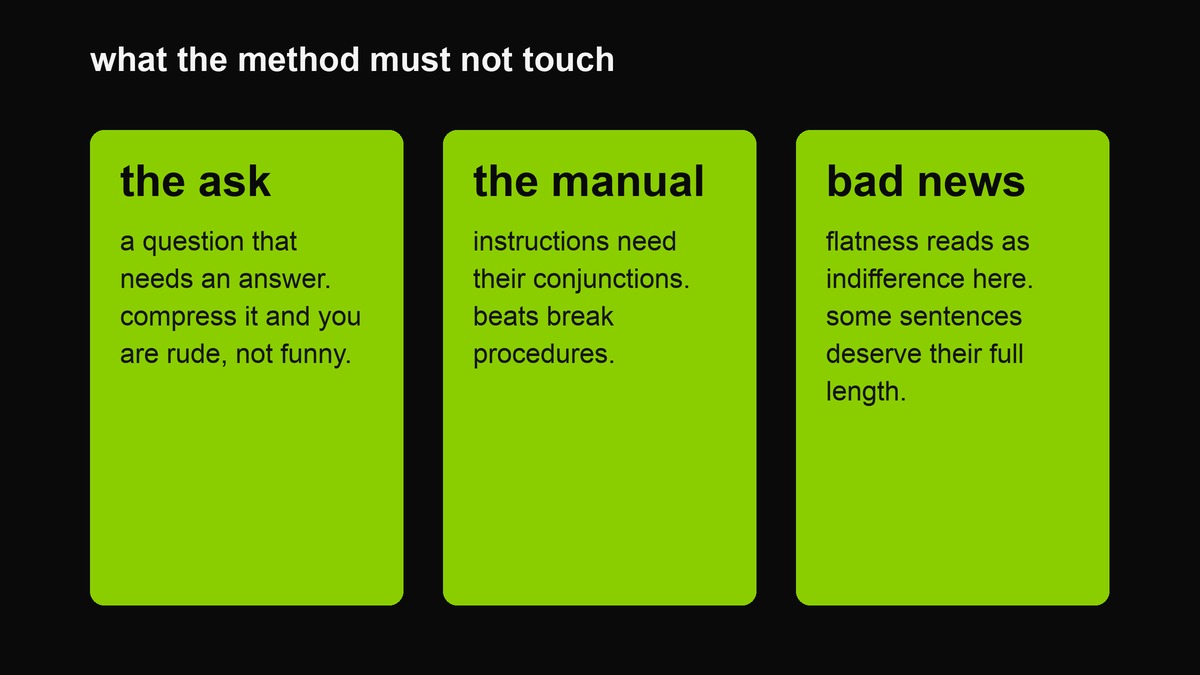 Three sentence types the method should not touch. Each fails for a different reason.
- The genuine ask. “Does anyone know a good dentist” is not a statement with an attitude; compressing it makes it rude without making it funny. Leave the ask as a sentence.
- The technical explanation. Instructions need their conjunctions. Pass five will break a how-to into beats and the beats into complaints.
- Bad news about someone. The format’s flatness reads as indifference, and indifference toward a real misfortune reads as cruelty. This is the one place where the register’s mechanics work against it.
Before the how-to, the honest warning about lists like this one: familiarity is the enemy. Read thirty rewrites and you will start producing imitations of them — lines that scan as this format but say nothing specific, which is the difference between a voice and a costume. The counterweight is to treat every pair here as a demonstration of a move, never as a line to post.
Five ways amateur attempts get this wrong
Reading thirty rewrites backwards tells you what the common failures look like, and they cluster tightly.
- Short but empty. Cutting words without keeping a concrete noun produces “vibes. tonight.” — the shape of the format with none of its content. Length is a consequence of compression, not the goal.
- Shouting quietly. Lowercasing an exclamation. The register is not volume turned down; it is certainty with the performance removed. If the sentence still needs you to be excited about it, it is the wrong sentence.
- Beat spam. Six one-word beats in a row reads as a list of tags, not a line. Two or three beats, with one longer among them, is the whole rhythm budget.
- Borrowed edge. Attitude imported from someone else’s specific life — their bar, their ex, their 4am. It reads as costume within a post or two, because the details do not compound into a person.
- Explaining the joke twice. A line plus a caption that restates it. The second surface should carry the context the first refused; repeating the punchline is the surest sign a post was written defensively.
Each of these is fixable by one of the seven passes, which is the useful thing about a mechanical method: when a line fails, you can usually name the pass that was skipped rather than waiting for a better idea.
Build your own list
The durable version of this exercise is a personal bank. Take twenty things you actually posted or said this month, run the seven passes on each, keep the ten that survive being read aloud, and rotate them back into use with one detail changed. After a season you have a list that sounds like you rather than like a format — which is the only kind of list worth keeping.
Two rules for your own bank. Tag each line with the move it demonstrates, so you can see which pass you keep skipping — most people discover they never do pass six, and that one habit explains why their lines finish flat. And prune one line every time you add one; a bank that grows without limit becomes the same thirty sentences wearing different hats, which is exactly the failure this page is at risk of becoming in your hands.
Where do I get my own thirty?
Your outbox. Sent messages, captions you deleted before posting, the text you typed into a notes app at 2am — all of it is raw material, and it is the only source that produces lines with your specifics already loaded in. Export twenty sentences, rewrite them, and you will know more about your own voice than any swipe file teaches. Tag each result with the move that fixed it; after twenty you can see which pass you skip, and that single habit is worth more than the rest of this page.
FAQ
Are these lines free to use?
Yes — they are yours to post, adapt or print. What you should not do is republish the list itself as your own content; the value is in the notes, and copying those is a different kind of borrowing.
Why do so many end with a full stop?
Because a final stop adds deadpan weight, and deadpan is the register’s default. If you run a series, pick one punctuation policy and keep it — the consistency guide covers why the policy matters more than the choice.
Can I generate these instead of writing them?
The caption generator deals ten hand-written lines per scene and is a good way to break a blank page. It cannot supply your specific detail, which is the part that makes a line yours — so treat it as raw material, not as the finished post.
Do these lines work on a photo, or only as text graphics?
Both, with a caveat. Over a photo the line competes with the image for attention, so it has to say something the picture does not — a time, a verdict, a denial. A line that describes the photo is a caption, not a poster, and the format wastes itself there.
How often should I post from this list?
Never directly, and that is the whole advice. Use a pair as a move demonstration, then apply the move to a sentence from your own outbox. Two posts that share a borrowed line read as a person with a sticker pack; two posts that share a technique read as a person with a voice.
Which pair is the best model to copy?
Number 13 — the “I don’t think I am the problem” one. It is the clearest single demonstration of the register’s core trick: delete the hedge and the same words change posture from defensive to certain.
The compression principles behind all thirty are the public-sector ones summarised at PlainLanguage.gov; the reason brevity functions on screens rather than merely looking stylish is Nielsen Norman Group’s reading research. This site is independent and unaffiliated with any artist or label.