
This site sells nothing but a way of writing: short, lowercase, flat, a little rude. So it is responsible for saying plainly where that voice stops being funny — and this page is the single place we say it. Two earlier articles covered the same ground from different angles; they now redirect here, and everything worth keeping from them is folded in below.
The short version, for anyone who will not read three thousand words: the target is the whole question. The register is delivered rudeness, and delivered rudeness is delightful when it lands on a situation, a habit, an institution or the writer themselves. Move it onto a specific person who has not opted in, and it is not edgy humour — it is harassment wearing a font.
What the register actually is
Strip the aesthetic away and this voice has three moving parts: certainty (no hedging), compression (two or three beats), and a flat delivery of something that would be embarrassing to say warmly. That last part is the engine. The format is funny because it says the unsayable-looking thing while pretending not to care that it is saying it.
Which is precisely why it needs a boundary stated out loud. A voice whose entire mechanism is “saying it without apology” has no internal brake. Politeness-based humour self-limits because the writer can feel themselves being rude; this register does not — rudeness is the deliverable. The brake has to be external and deliberate, and it is the rest of this page.
Four tests that draw the line
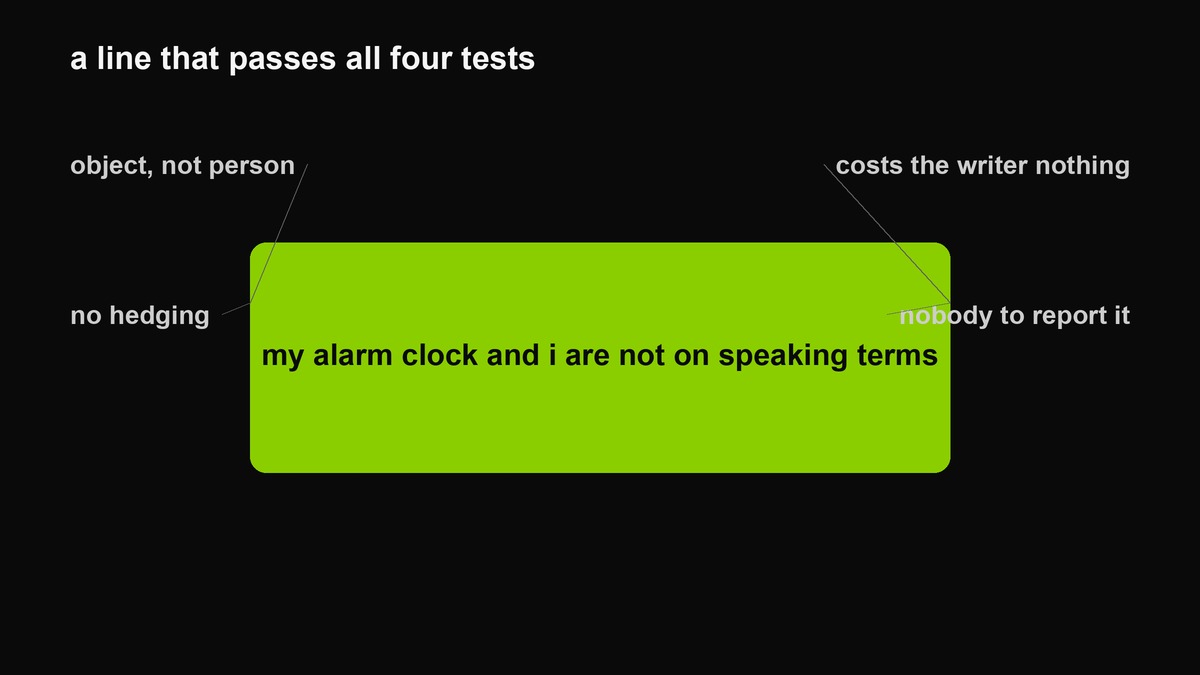 A line that passes all four tests. The target is an object, nobody is being told what to think of themselves, and the joke costs the writer something.
Test one — can the target be a situation?
If the joke works equally well aimed at the alarm clock, the group chat, Monday, or a generic institution, aim it there. The moment a line only works about one identifiable human being, you are no longer writing in the register — you are writing about a person, which is a different genre with different consequences.
Test two — who has more power?
Punching up at institutions, norms and abstractions is the whole tradition this voice comes from. Punching down at a colleague, a service worker, a stranger, or anyone whose job is to tolerate you is not a joke style, it is a stack. “Punch up” is a cliché because it is a shortcut for “check which direction costs something.”
Test three — is the person in on it?
Friends roast friends because the roast is a form of address, not an assessment. That only holds with consent you have actually observed rather than assumed — the group chat that has been exchanging insults for three years, not the acquaintance you met once. If you cannot name the moment they opted in, they did not.
Test four — does the line cost the writer anything?
The reliable tell of a mean line dressed as a funny one is that the writer is safely outside it. Self-deprecation costs something; observation about someone else’s appearance, family, job or body costs the writer nothing and the target plenty.
The three techniques that keep the edge and drop the target
These are the workhorses — each produces the same felt effect of “sharp” without requiring a victim.
The observation flip
Take an ordinary frustration and reverse who is judging whom. “I keep hitting the same alarm snooze” becomes my alarm clock and i are not on speaking terms. The aggression is fully intact; it is just aimed at an object with no feelings. This is the single most reusable move in the format.
Hypothetical absurdity
Escalate a small thing into an impossible scenario instead of escalating it into a person. “I have too many browser tabs” becomes 47 tabs. i live here now. tell my family. The comic charge comes from scale, not from a target — and scale has no victim.
Analogy over assault
When the honest subject really is a person or a behaviour, compare rather than accuse. “my group chat is a support group that failed its inspection” says everything “you are all unhinged” says, but it indicts the room rather than the people in it. Analogy keeps the diagnosis and removes the defendant.
Why the shape survives the repair
The objection people raise to all of this is that boundaries castrate the joke — that a line without a victim is just a caption. Look at the twelve pairs above and the opposite is visible: the rhythm, the case, the flatness and the compression are all untouched. What changed was one slot in the sentence — the thing the aggression is aimed at.
That is not an accident of politeness. The register’s actual pleasure comes from delivery, not from content: the reader enjoys the way the thing is said. Aim a line at a person and you introduce a second, uglier pleasure into the room — the audience starts enjoying the hit rather than the voice. That is the moment the format becomes something else, and it is also why the repaired versions tend to be better jokes: an object cannot defend itself, but it also cannot make the reader complicit.
There is a craft reason too. Situations are infinite, specific people are not. A voice that only works when pointed at someone runs out of material in about nine posts, which is exactly the lifespan of most accounts that do it.
Funny without mean: the three levers
Where the techniques above redirect aggression, these generate the laugh from somewhere else entirely.
- Exaggeration. The register’s hyperbole is affectionate by default: feral. certified. in writing. Overstating your own state costs nothing and reads as confidence, which is the exact feeling people want from this format.
- Self-deprecation. The safest target is the writer, with one limit: do not describe a real hardship as a joke if the audience cannot tell whether you are joking. Light flaws — snooze buttons, tabs, snacks — work. Actual suffering reads differently depending on who is holding the phone.
- Playful teasing. Only on shared ground, meaning material both parties have already laughed about. The test is embarrassingly simple: if they have not made the joke first, you do not own it yet.
Twelve lines, side by side
Same shape, two outcomes. The left column stays inside the register; the right column is what happens when the shape gets pointed at a person.
| In bounds | Crossed | What moved |
|---|---|---|
| the group chat is a support group that failed inspection | the group chat is full of losers | institution vs people |
| my alarm clock and i are not on speaking terms | she is so lazy, always late | object vs named person |
| feral. certified. in writing. | feral. like your sister. | self vs someone else’s family |
| 47 tabs. i live here now. | look at this idiot’s desktop | own habit vs someone’s |
| the meeting could have been an email. i could have been asleep. | he could have been an email | process vs colleague |
| out of office. into the weekend. | finally, without them | self vs a group excluded |
| new gym. old me. we will see. | new gym. seeing you there, [name] | body neutrality vs a witness |
| the barista knows my order. that is intimacy. | the barista looks exhausted | ritual vs a worker’s state |
| i am not lazy. energy efficient. | some of us are just lazy | self vs a category of people |
| cooked. happily. | she is cooked | first person vs third |
| the plot is doing fine without your input | addressed at one specific reply | general vs a quote-tweet target |
| do it for the plot | do it for the plot, [their worst idea] | motto vs a mocked attempt |
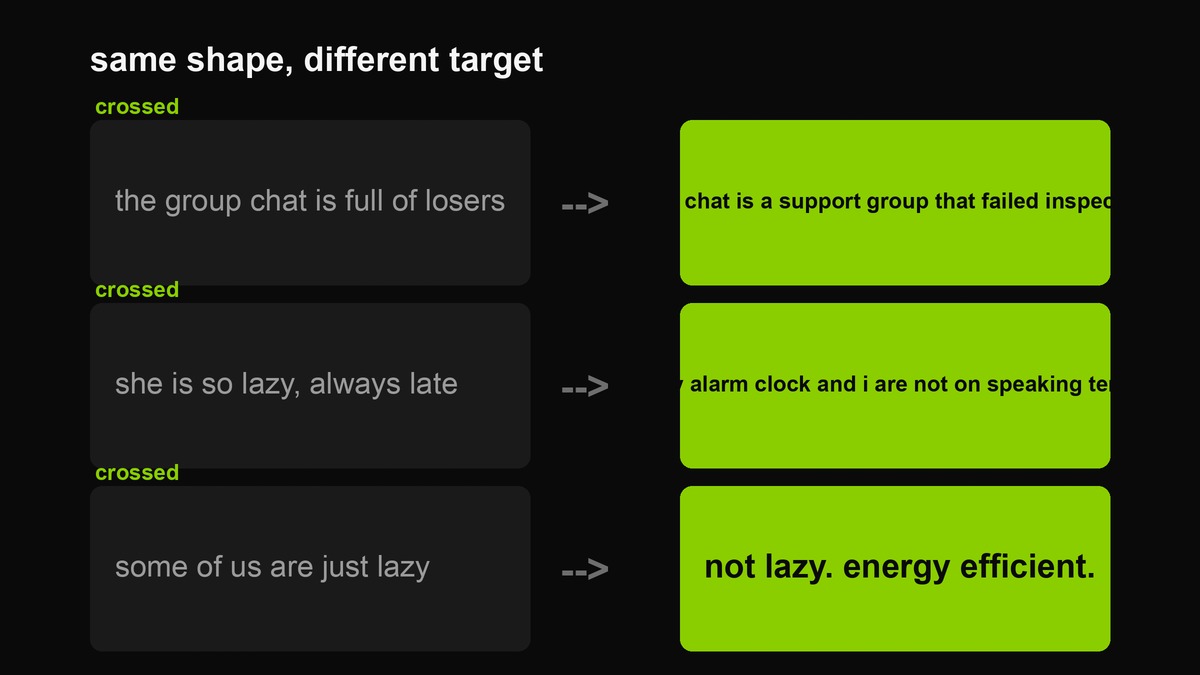 Three repairs. Notice the shape never changes — only the target does, and the joke survives intact.
Templates that are safe by construction
Grammar that cannot reach a person, because it has nowhere to put one:
- [thing]. [time]. [verdict]. — pasta. 2am. worth it.
- not [old state]. [new state]. — not tired. retired.
- [institution] and i have an understanding. — the printer and i have an understanding.
- [number]. [escalation]. [denial]. — three coffees. no sleep. fine.
- [noun] is my personality now. — the commute is my personality now.
Every one of these takes an object, a habit or a place in the subject slot. That is not a limitation of the format — it is the format working as intended.
Scripts, because the moment is fast and you will not think
To the person, privately: “that one was aimed at you and it shouldn’t have been. deleted. sorry.” Four sentences, no defence, no request for reassurance. Do not add “you know I’d never actually…” — that asks them to manage your image.
To the room, if it blew up: “posted something at a person instead of a thing. bad call, it’s gone.” Public, plain, once. The register’s own voice, applied to the only moment it should not be used for comedy.
To yourself, afterwards: the urge to make a follow-up joke about the reaction is the actual test. Every account that has died publicly died at that second post, not the first one.
What not to say, in order of how often people say it: “it was a joke” (restates the crime), “you’re all too sensitive” (aims at the objectors, escalating), and “I can’t say anything anymore” (converts a specific mistake into a grievance, which is the version that never ends).
When the room says you crossed
It will happen anyway, because intent and reception are different machines. Three rules for handling it, in order of how much dignity they preserve.
Delete, do not defend. A public argument about whether the line was funny is a much worse post than the line was. Deleting is not an admission that you are a bad person; it is the cheapest possible repair.
Skip the non-apology. “Sorry if anyone was offended” is a hedge, and hedges are the thing this whole register exists to delete. If you are going to say something, say the real one: you aimed at a person, that was the mistake, done.
Do not re-aim at the objector. The follow-up joke about people complaining about the joke is the single most reliable escalation in social media, and it converts one crossed line into a pattern, which is what actually costs accounts.
Setting the rules in a group chat
Most of this is easier to prevent than to repair, and a chat can be given a working culture in about two sentences. The useful version is not a list of banned words — it is a rule about consent and direction: we roast each other, we do not roast anyone who isn’t in here, and anyone can call a time-out on a bit without a debate about whether it was funny.
The mechanism that makes it stick is reciprocity. Teasing survives when everyone has had a turn and everyone has given one; it curdles the moment one person is the permanent target and the rest are the audience. A host who notices that pattern — and rotates the room’s aim — keeps the bit alive for years. A host who lets it settle gets a chat that reads as mean and quietly loses its best member.
Same logic scales to a public account: a voice that punches at the same person repeatedly is not comedy any more, it is a campaign, and audiences can tell even when the platform cannot.
What platforms actually enforce
Harassment policies are vague on purpose — they have to cover everything from a coordinated pile-on to a mean comment on a photo — which means the enforcement risk is not proportional to how cutting your line is. The variable that gets accounts into trouble is volume of reports against a named target, not the wit of the sentence. A joke about an institution cannot generate that pattern. A joke about a person can, and does, regardless of how good the joke is.
There is also an honest commercial note: this format is monetised by advertisers who can opt out of content that names people. The register is at its safest, and earns the most, when it never gives a brand a reason to blink.
FAQ
Is this site telling me what I am allowed to joke about?
No. It is describing where the format stops working, in the same way a typography guide describes where a font stops being legible. You can point the voice at a person; it just stops being this thing and becomes something with a worse reputation and a shorter lifespan.
What about comedy that genuinely punches down and is considered great?
It exists, and it survives because the comedian has a body of work, a context, and an audience that knows the difference between a persona and a belief. A caption on a green rectangle has none of those. The craft argument is not “never be cruel”, it is “cruelty requires more equipment than you have in this format.”
Can I use the generator for comebacks?
The tools are aimed at situations on purpose — the caption bank, the translator and the quiz all punch at habits, times, objects and the writer. A comeback is a person-shaped target with a timestamp. Use a group chat for that; use the format for the rest.
Does the register get safer as an account grows?
It should, and usually the opposite happens. Small accounts punch at people because that is the only material available; established accounts punch at institutions and habits because they have an audience that shares them. If your line needs a specific target to work at three hundred followers, it will not work at thirty thousand either — it will just be archived, searchable, and quoted by people who did not have to be there.
I already posted something that crossed. Is deleting enough?
Usually yes, and it is always better than the alternatives. If the person is in your actual life, the repair is a private message, not a public post about the private message. If it spread, delete, say the plain thing once, and stop posting for a day. The register is about not over-explaining; that is a good instinct everywhere except here.
Sources
- StopBullying.gov — the US federal definition of cyberbullying, including the repetition and power-imbalance elements that separate a roast from a campaign.
- American Psychological Association — research overview on online aggression and its effects on targets.
- U.S. EEOC — the workplace harassment standard, relevant to anyone running this voice on a work account.
This page consolidates two earlier articles on the same subject. It is opinion and craft guidance, not legal advice. This site is independent and unaffiliated with any artist or label.
[…] keep a longer treatment of this with rewrites and examples in brat humor without harassment. The short version for game hosts: the room decides, the host enforces, and the host should be […]
[…] you make. The fuller argument, with rewrites that keep the edge while dropping the target, lives in brat humor without harassment. The one-line version: sharp beats cruel anyway; cruel reads insecure within four […]
[…] This guide has been merged into one page so there is only one place to read it: BRAT humor without harassment: where the line is. […]
[…] They are also not for aiming at a person. Every line here targets a situation, a habit, an object or the writer — that is not an accident of taste, it is the boundary that keeps the format funny rather than mean. The longer treatment, with rewrites that keep the edge and drop the target, is in brat humor without harassment. […]