
Group chats run on bits, and most bits die within a week because they need too much effort to keep alive. The format this site is built around — lowercase text on a flat acid field — is one of the rare exceptions, because participating costs about forty seconds and produces something the whole room can argue about. This guide collects twelve games you can run with a brat generator, a group chat and nothing else. Some are two-minute icebreakers, some are season-long bits, three of them are designed for actual roleplay tables.
Why this format works as a game engine
Three properties make it unusually good for group play. First, the tone is pre-installed: lowercase text on that green already reads as confident and slightly ridiculous, so players do not have to be funny writers — the format does half the joke. Second, the output is a postable object: a cover or card is an image, and images stop the scroll in a way plain text never does. Third, participation is nearly free: the entire cost of entry is typing one line. Games die when the effort-to-fun ratio slips; this one starts with the ratio heavily in your favour.
The corollary is also true and worth saying once: because the format is easy, the quality bar is carried entirely by the writing. That is a feature. The games below are built to make average people produce above-average lines by giving them a constraint instead of a blank box.
The games
Instant games (no prep, two minutes to learn)
1. Caption Battle
Post one photo — a group shot, a cursed screenshot, last night’s dinner. Two players (or two teams) each generate ten captions from the same scene, pick their best, and the room votes. Winner pins the photo with their caption on it. The version that keeps a group chat alive for months: run it weekly, track wins, retire the photo after three rounds so the well does not run dry.
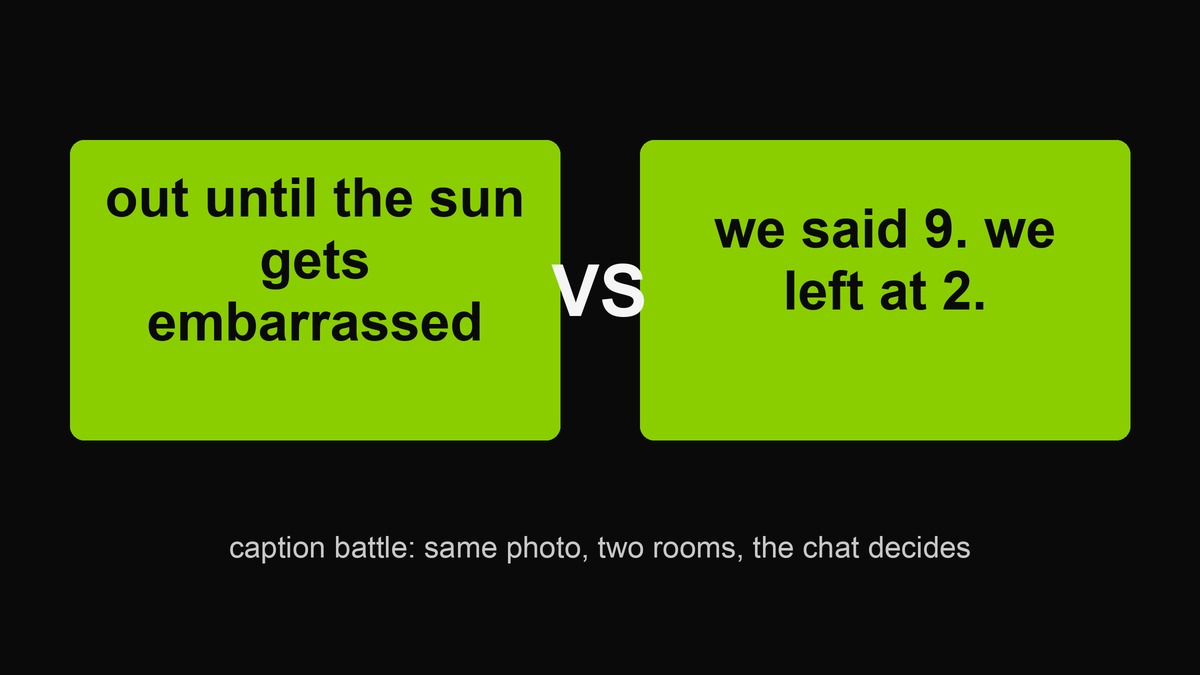 Caption battle in one image: same photo, two rooms, and the chat decides. The loser gets read aloud in its original corporate form.
2. Rewriter Duel
One player posts a maximally corporate sentence — the more hedging and jargon the better. Everyone runs it through the translator (or rewrites by hand), pastes the results, and the original author picks a winner. The losing sentences get read aloud in their original form as punishment. Rotating the judge every round is what keeps it from becoming a popularity contest.
3. Brat or Not
The purest game here and the fastest. One player posts a line — theirs, a friend’s, a song lyric, a fortune cookie. The room replies with one word: brat or not. Three not verdicts and the line is dead. The house rule that makes it work: a line must be one breath long, and explanations are banned. It is a vibe check, not a seminar.
4. Three-Word Cover
Everyone gets sixty seconds and exactly three words to make a cover on the generator. The constraint does the work: with only three words available, players reach for specifics instead of jokes, and the results are funnier for it. Best cover becomes the group icon until the next round.
Quiz games (for groups that like a scoreboard)
5. Brat Index Party
Everyone takes the five-question quiz, downloads their result card, and posts it in the chat simultaneously — simultaneous posting is non-negotiable, or everyone just copies whoever went first. The podium sorts itself out from there. Screenshots of the results make the card permanent; the argument about whether the quiz is accurate is the actual entertainment.
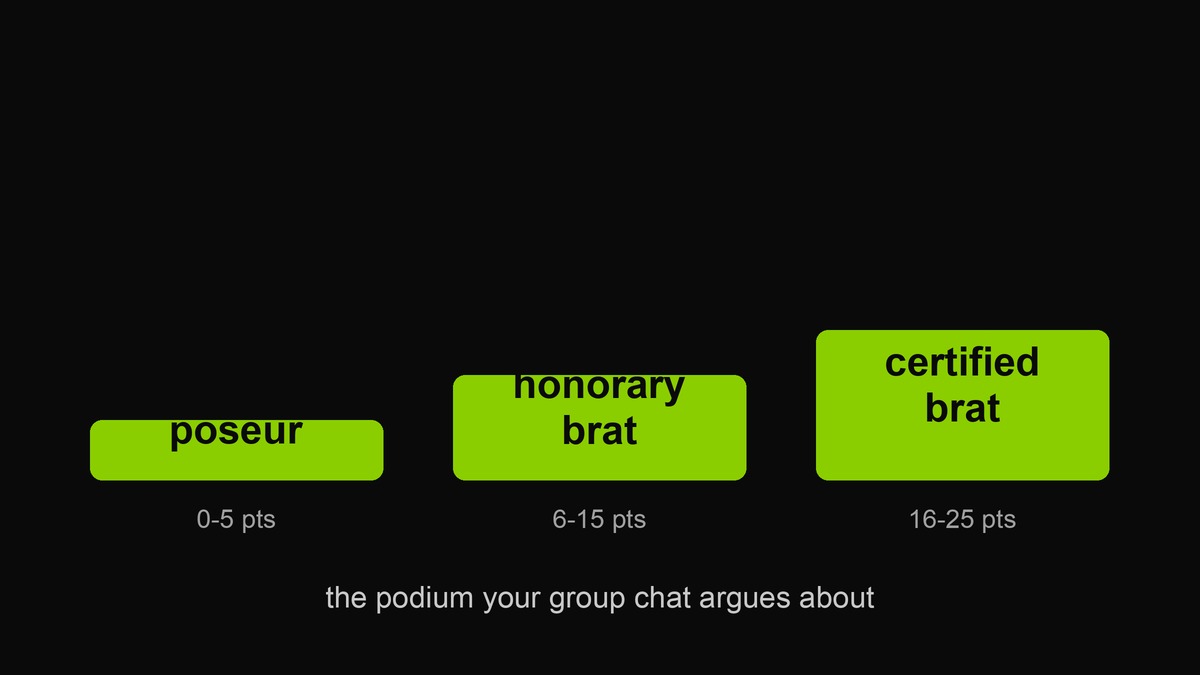 The podium your group chat argues about. The tiers are fixed arithmetic — the arguments are not.
6. Podium Politics
The follow-up bit to game five. Everyone who scored honorary brat gets ninety seconds to explain which single answer ruined them, and the room votes on whether a retake is justified. Limit retakes to one per person per season or the scoreboard means nothing. The phrase “the quiz is rigged and I have evidence” should appear at least once per cycle; that is the game working.
Long-running bits (seasons, not sessions)
7. Group Chat Spotlight
Whoever produces the best line of the week — by vote or by dictatorship — gets it made into a cover and pinned for seven days. The caption generator exists for the days the well runs dry, but the standing rule should be that borrowed lines are eligible and appreciated. A weekly cadence is the heartbeat; anything faster and the spotlight stops meaning anything.
8. Last Line Standing
A bracket tournament. Each round pairs two players on the same prompt; the room votes, losers are eliminated, and the final is best-of-three with the prompt chosen by the eliminated players. Keep the whole thing inside one week — tournaments that outlive their group’s attention span die at the semi-final stage with remarkable consistency.
9. Cover Pictionary
One player is dealt a secret phrase — a film, a song, an idiom, a group in-joke — and must make a cover whose two or three words hint at it. The rest guess. The skill is in compression: too obvious and nobody is challenged, too obscure and the round stalls. House rule that improves it: the phrase’s exact words are banned from the cover.
For actual roleplay tables
10. Character Voice Drill
Take a line your character says in an ordinary scene and rewrite it in the register — hedging removed, specifics added, punctuation gone. Do it for three lines before a session and the voice holds for the whole evening. The point is not to make every character identical; it is to find which parts of the register fit the character and which to deliberately keep out.
11. Alter Ego Bios
Build each character a profile with the bio and username generator, seeding it with one word that captures them. Post the whole set to the table before session one. It sounds like procrastination; in practice it settles voice, priority and who finds whom annoying before the first scene starts, which is most of what a session zero is for.
12. Scene Starter Cards
Before the session, deal three random captions from the caption generator to each player, face up. At any point a player may burn a card to force its line into the scene as an event, an overheard remark or a poster on a wall. It is the pressure valve for stalled scenes — and the reason the caption bank being hand-written matters: the lines are strange enough to steer with.
Hosting them without it falling apart
A bit of setup separates a season of games from a single chaotic evening. On Discord, give each running game its own channel and pin the rules — one channel per bit means the argument about round four does not bury someone’s birthday plans. In a plain group chat, keep a pinned leaderboard message and update it weekly. Export covers as images rather than describing them; the template maker handles the ratios, and the sticker maker turns recurring winners into reaction stickers, which is how a bit becomes furniture.
The cadence rules matter more than the tooling. One competitive game running at a time per chat. Weekly results, not daily. And every game ends its season — four to six weeks — with a winner celebrated more than is reasonable, because the celebration is what people come back for.
How bits die, and the fixes
Three failure modes account for nearly every dead game. Voting fatigue: the room stops voting when prompts arrive daily – fix it by scheduling, not by begging. Leaderboard creep: one player runs away with the season and everyone else stops trying – fix it with handicap rounds where the leader must use three-word prompts only. Drift: the game channel becomes general chat – fix it by keeping exactly one competitive bit running at a time and retiring finished games loudly, with a small final. None of these need new tools; they need a host who closes things.
A six-week season, on one page
For hosts who want the whole thing scheduled rather than improvised: week one, Brat or Not nightly to teach the register, no scores. Week two, first Caption Battle, results pinned. Week three, Rewriter Duel joins the rotation and the leaderboard goes up. Week four, Brat Index Party and Podium Politics over a weekend. Week five, Cover Pictionary bracket. Week six, the finale: Last Line Standing between the two top names, winner gets a permanent sticker and the chat icon. Then the season ends on purpose, and whoever enjoyed it most gets handed this article and runs the next one.
Season zero: the first forty-eight hours
Most bits are decided before the first vote. Post the first round yourself and let the group respond to a completed example rather than an announcement — nobody joins a game that only has rules. Make the losing condition genuinely funny by pre-seeding one deliberately bad entry; a room that has seen a spectacular loss knows the stakes are safe. And never explain your own entry. The moment a host starts footnoting their joke, the room learns that entries need defending, and the games stop producing anything brave enough to argue about.
The rules of the line
This register is delivered rudeness, which is exactly why the boundaries need saying once, plainly. The target is always a situation, a habit, an institution or the player’s own self — never a specific person’s body, family, job or identity, and never anyone who has not opted into the game. A group that has agreed to play is consenting to the format, not to becoming its subject. If a bit needs a specific person to feel it, it is not a bit.
We keep a longer treatment of this with rewrites and examples in brat humor without harassment. The short version for game hosts: the room decides, the host enforces, and the host should be someone who will actually do it.
What you need, in one list
| Tool | Used by | Why |
|---|---|---|
| The generator | Games 4, 9 | Covers and anything text-on-a-field |
| Caption generator | Games 1, 7, 12 | Deals ten lines per scene when the well is dry |
| Slang translator | Game 2 | Compresses corporate input into the register |
| The quiz | Games 5, 6 | Produces the result cards the podium runs on |
| Sticker maker | Game 7 | Turns recurring winners into reaction stickers |
| Template maker | Any game | Platform-correct export sizes |
Every tool is free, needs no account and runs entirely in your browser. Nothing you type in a game is stored or sent anywhere — which, since half these games run on material you would not want logged, is not a small feature.
What the games are actually training
It is worth being honest that these are not really games about being funny. Caption Battle trains compression — saying a thing in fewer, more specific words. Rewriter Duel trains tone detection — hearing where hedging lives in a sentence. Brat or Not trains collective judgment, which is the skill every group chat is secretly running all the time anyway. The cover games train restraint: one field, one word, nothing to hide behind.
That is also why the hand-written caption bank and the fixed rewrite rules matter more than they first appear. A model would produce fluent lines that all sound alike; a curated bank with sharp edges produces lines worth arguing about, and the argument is the game. Everything on this page works because the tools underneath it are opinionated.
FAQ
Do we need this site to play?
No. Every game here works with any text field and any group chat — the tools just make each round faster and the outputs postable. The games are the rules; the site is the convenience.
Is the generator AI?
No, and it never was. It is fixed rules and a hand-written bank running in your browser. An earlier version of this article said otherwise; that is what the correction at the top is about. Practically it means output is consistent enough to judge fairly, which several of these games depend on.
What is the ideal group size?
Four to ten for the voting games — enough for real margins, few enough that everyone’s turn arrives often. Caption Battle and Rewriter Duel work with as few as three; Brat Index Party scales to any size because it needs no turns at all.
Can we play these in person?
Yes — pass one phone around, or generate the covers in advance and run the voting by pointing. The quiz game in particular works well on a TV with everyone taking it on their own device and revealing together.
Our group is not funny. Will this still work?
The format lowers the bar on purpose: the colour and the lowercase carry the tone, constraints replace writing skill, and voting replaces comedy. Groups that describe themselves as unfunny produce the bestCaption Battle results precisely because they argue longer about the winner.
Which game should we start with?
Brat or Not on night one, Caption Battle as the first weekly fixture, and Brat Index Party whenever the chat needs a jolt. That order teaches the format with the lowest possible effort and produces the pinned scoreboard the other games feed on.