
MICRO-AESTHETICS · GLOSSARY
Micro-aesthetics, defined
brat · demure · clean girl · Y2K · coquette
A micro-aesthetic is a named visual style that spreads online fast, bundles a look with a posture, and usually burns out in a year or two. This glossary defines the five that matter most right now — what each one is, where it came from, what it signals, and the catch nobody mentions.
Each term has its own page with the full breakdown, sources and a one-line definition you can quote. The short version, the comparison table and the pattern behind all of them are here.
The five, at a glance
One-line definitions
If you only need the answer fast, here each of the five is in a single sentence. The linked page expands it with origin, the look, the posture and the catch.
- brat — a flat acid-green field with one lowercase blurred line, and a posture of not caring who sees it.
- demure — deliberate restraint — soft neutrals, correct case, a quiet composure — the thought you decide not to post.
- clean girl — no-makeup makeup and beige basics: dewy skin, a slicked bun, one gold hoop, effort sold as effortlessness.
- Y2K — the revived look of c. 1997–2004 — low-rise, velour, metallics, gloss — driven by Gen Z nostalgia.
- coquette — bows, lace and pastel pink, borrowing from Rococo and Marie Antoinette to make softness a power move.
Side by side
The fastest way to tell them apart is what each one is doing under the surface. Read the posture column and the differences stop being about clothes.
| Aesthetic | Peak | Origin | Signature | Posture | Defined against |
|---|---|---|---|---|---|
| brat | 2024 | Charli XCX album | acid green + lowercase | overshare | clean girl |
| demure | 2024 | Jools Lebron TikTok | cream + serif, tidy | withhold | brat |
| clean girl | 2021–23 | TikTok / Hailey Bieber | dewy skin, slick bun | discipline | mob wife |
| Y2K | revival 2021–22 | c. 1997–2004, revived | low-rise, gloss, sparkle | play | minimalism |
| coquette | 2023– | Rococo → Coppola → TikTok | bows, lace, pink | softness as power | grunge |
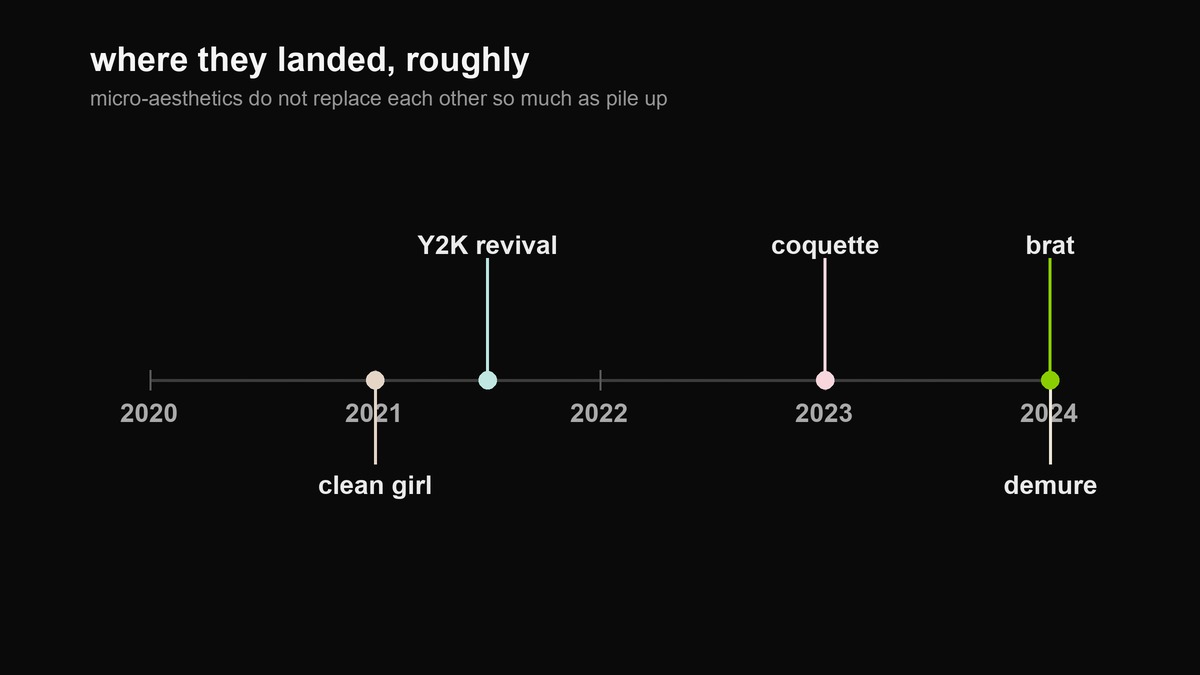
How a micro-aesthetic actually works
Almost every one of these follows the same arc, and knowing the arc is the most useful thing on this page. Someone names a vibe that already existed — the label, not the look, is the invention. It scales onto the For You Page and then onto store shelves. It ironises: the people who did it sincerely start doing it as a joke. It fractures into hyphenated subgenres. Then it retires into a costume you wear with audible quote marks. A few skip retirement and become permanent vocabulary — preppy, goth, normcore. Most do not.
Run brat through the arc and you can watch the whole machine. It was minted in June 2024 when an album shipped with a cover that looked like a mistake; it scaled within weeks into a summer, a word of the year and a presidential rebrand; it ironised almost immediately, as every brand discovered it could wear the green too, which is the moment the sincere version started dying; it fractured into “brat summer,” “brat core” and a hundred palette knock-offs; and it is now quietly retiring into a period reference that works best with a wink. The same five beats fit clean girl, demure and coquette, only at different speeds — which is why the honest question about any of them is never “is this real?” but “what stage is it on?”
How they relate to each other
These are not five unrelated trends; they are a small ecosystem that defines itself by opposition. Clean girl (composed, effortful, dewy) and brat (messy, unbothered, lowercase) are near-poles — brat arrived partly as a rejection of clean girl’s exhausting perfection. Demure is clean girl’s quieter cousin, and coquette shares its hyper-femininity but pushes it into costume. Y2K is the umbrella revival the others borrow from, and it is the reason brat’s rave-green feels familiar. Each one is easiest to understand against its opposite, which is why there are full head-to-heads for brat vs demure, brat vs cottagecore, and brat vs minimal.
Using a micro-aesthetic on purpose
The reason a glossary like this is useful to a brand, and not just to a spectator, is that these looks are shortcuts for a feeling. When you reach for one you are borrowing everything it already means, which is efficient right up until it is wrong. So pick from the posture column, not the palette: decide whether you want to read as energised or composed, sincere or ironic, nostalgic or current, and then choose the term that already carries that signal. Two rules keep you out of trouble. First, never borrow an aesthetic whose moral claim you cannot honour — clean girl sells discipline, brat sells honesty, and a brand doing either as a costume gets caught. Second, mind the clock: every one of these is on its way from sincere to ironic to retro, and using one dead-straight after its window reads as behind, not bold. The safe move is to use them knowingly, as reference, and to change one variable at a time so you can see what breaks.
FAQ
What is a micro-aesthetic?
A named visual style — usually two words ending in “-core” or a phrase like “clean girl” — that packages a look, a wardrobe, a posture and often a moral stance into one shareable label, and that spreads and ages far faster than older fashion movements did.
Why do they keep getting shorter?
Because the platform that mints them now also serves as their archive. A look that took four years to rise and retire in 2020 can complete the whole cycle in a single quarter now, simply because the algorithm notices things sooner and gets bored sooner.
Are these real styles or just hashtags?
Both, which is the point. The look is real and wearable; the label is a marketing and memory device bolted onto it. Knowing the difference is what lets you use an aesthetic on purpose instead of being used by it.
Which one should I use for my brand?
Start from the posture, not the palette. Ask whether you want to read as energised or composed, sincere or ironic — then pick the term that already carries that signal, and check that you can honestly afford its moral claim. The colour and the font follow.
Why only five?
These five are the ones people actually search for and confuse with each other. The glossary is built to grow — mob wife, goblincore, dark academia and balletcore all have a page waiting in the wings, and each new term slots into the same template and the same comparison table.
Definitions are this site’s summaries; every date and origin is attributed on the individual pages. Images are original graphics made in-house.