
Picture this: You’re in a group chat with friends, firing off a sassy comeback like, “Oh please, as if your outfit isn’t screaming ‘thrift store tragedy.'” Laughter erupts, high-fives (virtual or otherwise) follow. That’s brat humor at its finest—playful, cheeky, and zero malice. But swap the setting to a work Slack channel, target a colleague who’s sensitive about their style, and suddenly it’s not funny anymore. It’s a HR complaint waiting to happen. The line between bratty banter and harassment is razor-thin in our meme-saturated world, where “brat summer” vibes from Charli XCX have everyone channeling their inner mischievous imp. Get it wrong, and you risk damaged relationships, professional fallout, or worse. In this guide, we’ll dissect exactly where that line sits, arm you with crystal-clear examples of hits and misses, and equip you with practical strategies to keep your humor harmless. By the end, you’ll master brat humor that builds bonds, not bridges to burn.
What Exactly Is Brat Humor?
Brat humor thrives on exaggerated self-indulgence, defiance, and unapologetic sass. Think of it as the comedic lovechild of a spoiled toddler and a punk rock rebel—demanding attention with a wink and a smirk. Popularized recently through cultural moments like Charli XCX’s Brat album, it features quips that poke fun at entitlement, chaos, and minor rebellions. “I’m not arguing, I’m just explaining why I’m right” or “Sorry I can’t hear you over the sound of my crown” exemplify the style: light-hearted jabs that affirm the speaker’s playful superiority without targeting others destructively.
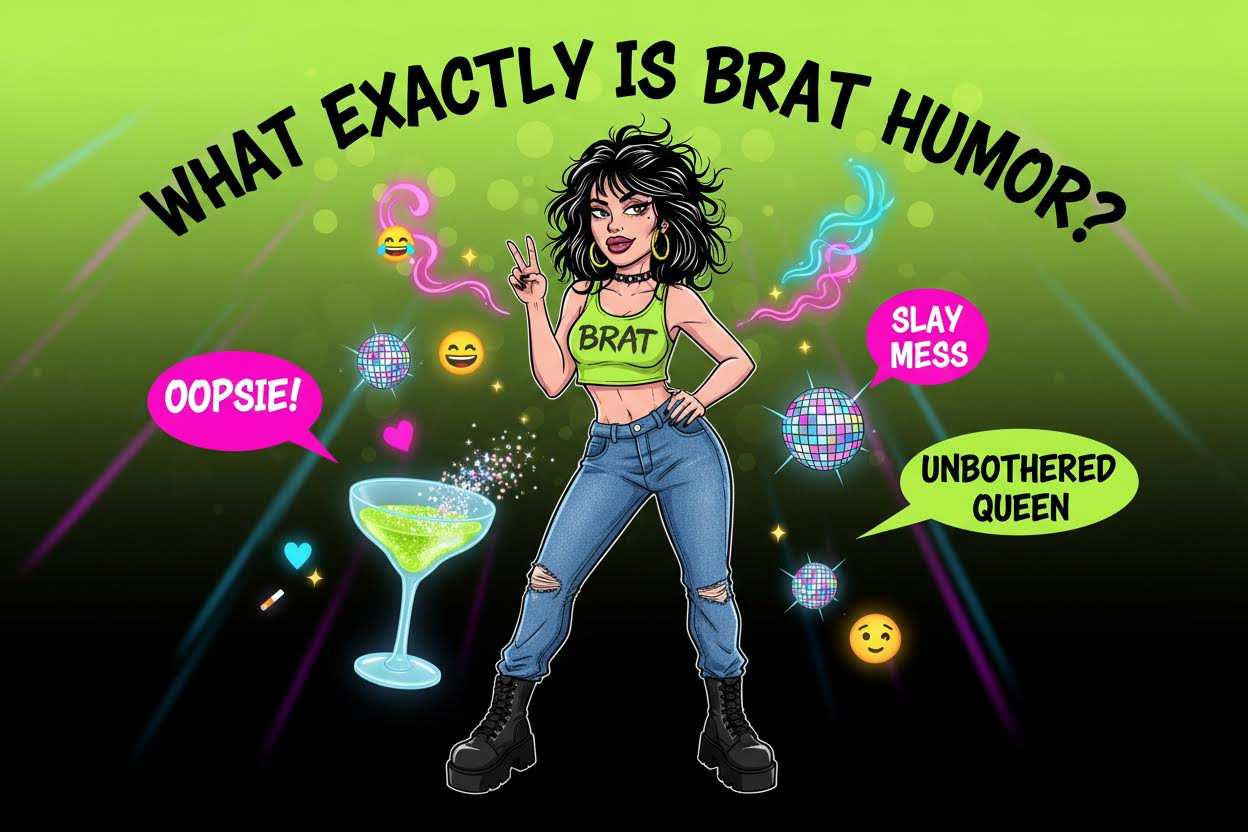
At its core, brat humor is self-referential and empowering. It often flips vulnerability into strength, like posting “Living my brat era: late to everything, zero regrets” on social media. This resonates because it humanizes imperfection while keeping things fun. But when aimed outward, the risk escalates. The “why” here ties to psychology: humor bonds us through shared absurdity, per research from cognitive linguists studying conversational implicature. Done right, it signals in-group trust; botched, it alienates.
Origins and Cultural Rise
Brat humor didn’t emerge in a vacuum. It echoes vaudeville “wise guy” routines and modern internet archetypes like the “Tumblr mean girl” or TikTok’s “feral gremlin” personas. Its explosion ties to post-pandemic escapism—people craving unfiltered fun amid uncertainty. Yet, as platforms like X (formerly Twitter) amplify voices, what starts as a solo post can snowball into pile-ons, blurring lines fast.
Harassment Defined: The Legal and Social Red Lines
Harassment isn’t just “mean words”; it’s a pattern of behavior creating a hostile environment. Legally, the U.S. Equal Employment Opportunity Commission (EEOC) defines it as unwelcome conduct based on protected characteristics (race, gender, age, etc.) that interferes with work or education. Socially, it extends to any repeated targeting that causes emotional distress, regardless of legality.
The key differentiator? Intent vs. Impact. Brat humor intends playfulness; harassment seeks domination or harm. But courts and HR pros judge by receiver’s perception. A single bratty quip might slide, but repetition without consent? That’s the slippery slope. Consider power dynamics: joking at your boss’s expense as a peer is risky; as a subordinate, it’s suicidal.
Protected vs. Punch-Up Humor
- Punch-up: Targeting the powerful (e.g., celebrities) is safer, as they opt into public scrutiny.
- Punch-down: Aiming at marginalized or junior folks amplifies harm potential.
- Self-deprecation: Pure brat—invulnerable because you’re the butt of your own joke.
Understanding this framework prevents 90% of missteps. Why? It shifts focus from “I’m just kidding” to “How does this land?”
Brat Humor vs. Harassment: A Side-by-Side Comparison
To make the distinction stick, let’s break it down visually. This table highlights core traits, helping you self-audit in real-time.
| Aspect | Brat Humor (Safe) | Harassment (Crosses Line) |
|---|---|---|
| Target | Self or consenting equals (friends who dish it back) | Non-consenting individuals, especially vulnerable ones |
| Tone | Playful exaggeration, wink implied | Personal attacks, belittling, repetitive |
| Frequency | Sporadic, context-specific | Persistent, ignores “stop” signals |
| Power Dynamic | Balanced or punch-up | Punch-down or authority abuse |
| Outcome | Laughter, rapport-building | Discomfort, withdrawal, resentment |
This matrix isn’t arbitrary—it’s distilled from workplace psychology studies and comedy ethics debates. Use it as your mental checklist before hitting “send.”
Examples of Brat Humor Done Right
Let’s get concrete. Here are vetted scenarios where brat shines, with breakdowns on why they work.
- Friend Banter: Friend A: “I’m running late.” Friend B: “Classic you, queen of dramatic entrances. Throne awaits?” Why it works: Reciprocated vibe, affectionate exaggeration. No specifics weaponized.
- Social Media Flex: “Just spilled coffee on my white jeans. Brat privileges revoked for 24 hours 😂.” Why: Self-mockery invites empathy, not envy.
- Team Meeting Icebreaker: Colleague shares a failed pitch. You: “Next time, we’ll add fireworks. Your ideas deserve pyrotechnics!” Why: Uplifts, ties to shared goals.
“The golden rule of brat: If they laugh with you, not at you, you’re golden.” —Comedy coach axiom, battle-tested in improv circles.
These land because they invite participation. Observers feel included, not attacked.
Examples That Cross into Harassment Territory
Now, the cautionary tales. These start brat-adjacent but devolve—spot the pivots.
- Workplace Fail: Repeatedly calling a coworker “Princess” for minor requests, even after they ask you to stop. Crosses line: Ignores boundaries, implies incompetence tied to gender.
- Online Thread: Commenting on a stranger’s photo: “Nice try, but that filter can’t save budget brunch.” Escalates to likes piling on. Why bad: Public shaming, no relationship buffer.
- Date Night Dud: Partner suggests a movie; you retort, “Your taste is why we need Netflix roulette—pure self-preservation.” Crosses: Undermines repeatedly, erodes trust.
The “how” to avoid: Pause for consent cues. A groan? Abort mission.
Actionable Strategies: Mastering the Brat-Harassment Tightrope
Knowledge without tools is useless. Here’s your playbook, step-by-step.
1. Read the Room (Context Calibration)
Online anonymity tempts excess; IRL micro-expressions reveal discomfort. Strategy: Mirror energy. If they’re bratty back, escalate playfully. Silence? De-escalate.
2. Build in Opt-Outs
- Preface with “In my brat era, bear with me…”
- End with “Kidding, you’re a legend.”
- Check in: “Too much?”
3. Amplify Positivity
Brat best when sandwiched: Tease, affirm, repeat. E.g., “Your cooking? Chef’s kiss… if chefs burned toast. But hey, passion points!”
4. Know When to Fold
Three strikes: No laugh, tense silence, deflection. Apologize sincerely: “My bad, that landed wrong.”
Pro Tip: Track patterns in a journal. “What worked? What bombed?” Patterns reveal your style’s safe zones.
These aren’t fluffy ideals—they’re honed from coaching comedians and mediating office spats. Implement, and your humor quotient soars.
Context Is King: Online vs. Offline Nuances
Digital amplification changes everything. A tweet roasts eternally; bar banter fades. Offline, tone conveys 55% of meaning (Mehrabian’s rule: 55% body language, 38% tone, 7% words). Online? Text-only, so err safer.
Platforms matter too:
- Private chats: Brat haven.
- Public feeds: Punch-up only.
- Professional spaces: Minimalist brat, max professionalism.
Pro data point: A American Psychological Association review on cyberbullying notes 59% of incidents stem from “joking” escalations. Lesson? Digital permanence demands precision.
Frequently Asked Questions
Can brat humor ever be okay in a professional setting?
Absolutely, but sparingly and symmetrically. Limit to established teams with mutual rapport. Example: During a low-stakes brainstorm, “Our deadline? More like ‘suggestive timeline’—let’s brat our way through.” Gauge reactions quarterly via anonymous feedback. If it boosts morale without complaints, green light. Otherwise, pivot to straight-laced.
What if someone calls my brat joke harassment—how do I respond?
Don’t defend; validate first: “I’m sorry that hurt—didn’t intend it.” Then clarify intent without excuses. Follow up offline: “Want to talk it out?” This rebuilds trust faster than “just joking” ever could. Document if needed, especially at work.
Is brat humor generational, and does that affect the line?
Gen Z owns it, but boomers get it via nostalgia (think Archie Bunker sass). The line shifts by cohort: Younger folks tolerate more edge; older prioritize respect. Bridge it by scaling to the most sensitive ear—universal buy-in maximizes fun.
How do cultural differences play into brat humor boundaries?
High-context cultures (e.g., Japan) read indirect barbs as aggression; low-context (e.g., U.S.) expect explicit play tags. Research cross-cultural pragmatics: Adapt by observing local norms. Global teams? Default to self-brat only.
Wrapping It Up: Brat Boldly, But Wisely
Brat humor is rocket fuel for charisma—witty, bold, unforgettable. But wield it like a scalpel, not a sledgehammer: Consent, context, and calibration keep it golden. Next time you’re tempted to unleash, ask: Does this empower or erode? Punch up, check in, and watch connections flourish. Your inner brat thanks you—and so will everyone else.